
study
When a Cloud Looks Like a Craft
The main essay gives my interpretation of the connection between these images and modern encounter accounts. This page records how the comparison was made, where its numerical test failed and what the comparison can support.
The atlas contains twelve historical artwork groups and a separately presented, historically unverified social illustration. The numerical pilot used the original eleven groups. The later Sighișoara panel and Instagram illustration received visual inspection only; neither was added retrospectively to the pilot.1
Keep the image and its setting together
The comparison began with 20 motif regions: six showing identified clouds, six showing other identified subjects, and eight selected for closer comparison. The twelve identified examples served as controls; the other eight were the probes. Tight and wider views produced 40 crops of these same regions. Each pair shows one motif at two scales. The crops preserve the source pixels without reconstruction, sharpening or restoration.1
Comparing the crops requires us to distinguish appearance from meaning. Shape concerns visible marks; iconography concerns their place in a work and its tradition; a report records what someone said they saw; physical identity requires evidence about what produced an observation. Each claim needs the source capable of supporting it.
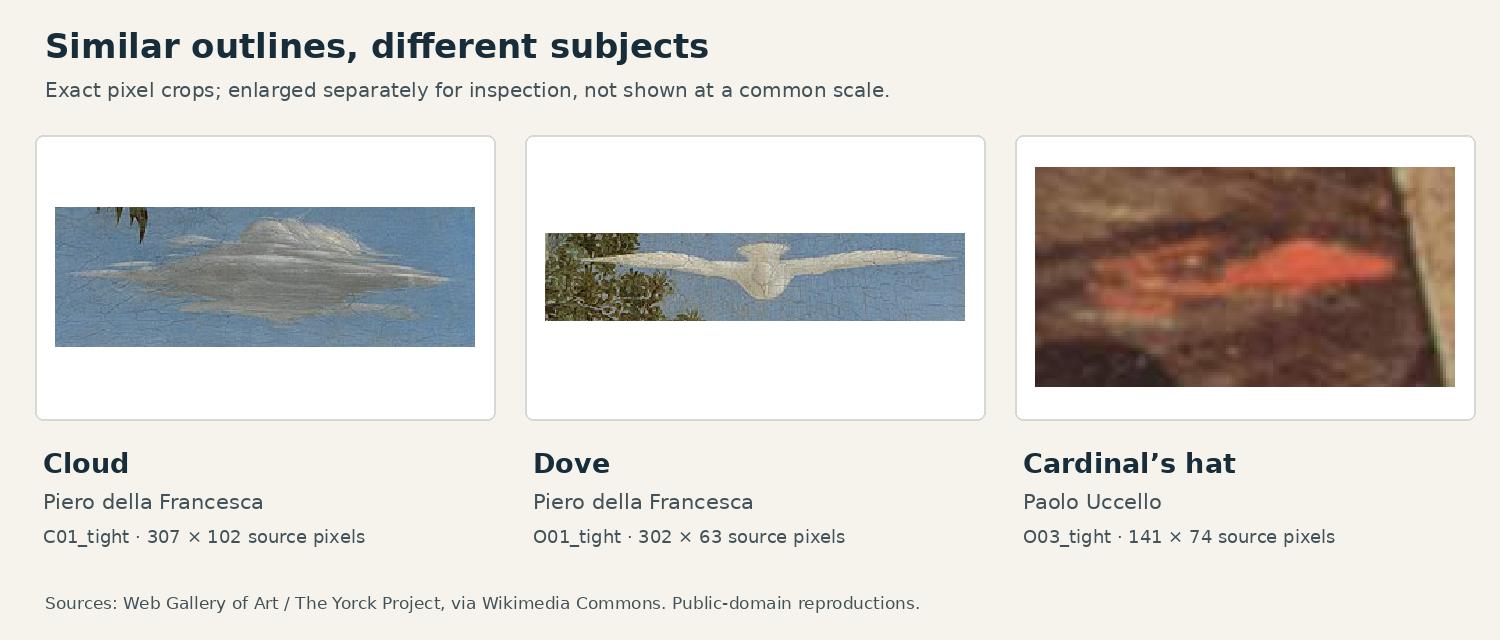


The cloud, dove and hat show why a recognisable outline is a starting point. Known noncloud controls also included a bowl, a globe and celestial personifications. They were never a reference class of vehicles.1
Testing similarity against known subjects
The experiment used the original 2021 DINO ViT-S/16 image model without retraining it on this collection. It converted each crop into a numerical representation, then measured similarity between those representations using cosine similarity. Each artwork was compared only with controls drawn from other works.21
The primary preparation fitted the whole crop inside a padded square. Separate sensitivity checks used standard centre cropping, wider context and reduction to 32 pixels along the longest edge before enlargement. Central cropping could discard much of a broad cloud or outstretched dove.
The nearest-reference comparison agreed with 5 of 12 control labels: one of six clouds and four of six noncloud controls. It failed to establish a reliable cloud/noncloud distinction. All six cloud controls came from only two paintings, entangling style with the category. Similarity could reflect colour, texture, framing or damage as well as shape.1
Four distinct probes out of eight changed their nearest reference group under at least one sensitivity check. The scores describe closeness within this small selected reference set, not probabilities of object identity. CLIP and segmentation were not part of the completed test recorded here. The pilot supplies no numerical identification of a craft.1
What the visual review retained
The separate, AI-assisted visual review coded nine features: a broad horizontal body, central dome, round or oval form, radial glow, rays or trails, paired placement, downward light, triangle or V shape, and elongated capsule. Across the 20 baseline regions, 14 were coded as broadly horizontal, 11 as round or oval and nine as having a central dome.1
This was one unblinded pass through a deliberately selected collection. The features overlap: a dome and an oval can describe the same contour; a descending streak can count as both a ray and downward light. The counts describe these images, not the prevalence of craft-like forms across Christian art. No inter-reader reliability estimate was produced.
The later Sighișoara and Instagram targets have separate qualitative records. Sighișoara’s ribbed oval retains competing historical readings. The Instagram scene has explicit saucer-and-light geometry, but its claimed age and production method remain unverified.1
Compare the particular, including what is missing
| Comparison | What carries across | What must remain distinct |
|---|---|---|
| Beaune, the Florentine oval and Sighișoara | Rims, flattened profiles and, in some motifs, a raised centre | Clouds, hats and period emblems can share these features; Sighișoara’s separate upper dome is unclear. |
| Salimbeni and the Middle East Object recording | Broad roundness and shading | Salimbeni’s globe and sceptres have an identified religious setting.3 AARO assessed no anomalous behaviour in the limited video and left the object’s identity unresolved.4 |
| Crivelli/de Gelder and Rendlesham | A sky source with light directed downward | Halt’s triangular-object account is in paragraph 1; downward light appears in a separate observation in paragraph 3, which does not say it struck a person.5 |
| Nimitz/Tic Tac and the art baseline | A useful contrast | Fravor’s reported elongated capsule has no convincing counterpart here. An extended bird or thin cloud does not supply that body.6 |
No clear compact triangular or V-shaped overall body was established in the baseline. One Dečani motif has an ambiguous envelope formed by rays. These nonmatches belong in the result alongside the repeated discs, ovals and globes.1
The next useful test
A stronger image experiment would select controls across independent paintings, periods and media, use multiple blinded readers and reserve whole artworks for evaluation. Those are proposed improvements, not completed tests.
The historical route is to trace a distinctive configuration through dated prints, panels, manuscripts or workshop records. An attached hand, ribbed underside or inscription may be more informative than a generic oval. Documentary transmission could establish how an image travelled; corroboration of a witnessed event would require a separate contemporary record tied to that work.
Footnotes
-
Dawson Ledger research, source summary, scope, feature definitions and results. Numerical results concern the original 20 regions; the two later targets have separate qualitative records. ↩ ↩2 ↩3 ↩4 ↩5 ↩6 ↩7 ↩8 ↩9
-
Mathilde Caron and colleagues, “Emerging Properties in Self-Supervised Vision Transformers”, 2021; official DINO implementation. This study used the original model, without retraining. ↩
-
Comune di Montalcino, Chiesa di San Lorenzo in San Pietro, identifies the central globe and the sceptres resting on it. ↩
-
Defense Media Activity/AARO, “Middle East Object”, captured 12 July 2022, published 19 April 2023. The assessment accompanies the source recording. ↩
-
Charles I. Halt, Unexplained Lights, 13 January 1981, memorandum scan, paragraphs 1 and 3. The National Archives’ August 2011 research guide, pages 12–13, identifies the original report and follow-up in DEFE 24/1512. ↩
-
David Fravor, written congressional statement, 26 July 2023; official hearing transcript. ↩
