
Work / Civilization / Civilizations / Greco-Roman
Greco-Roman
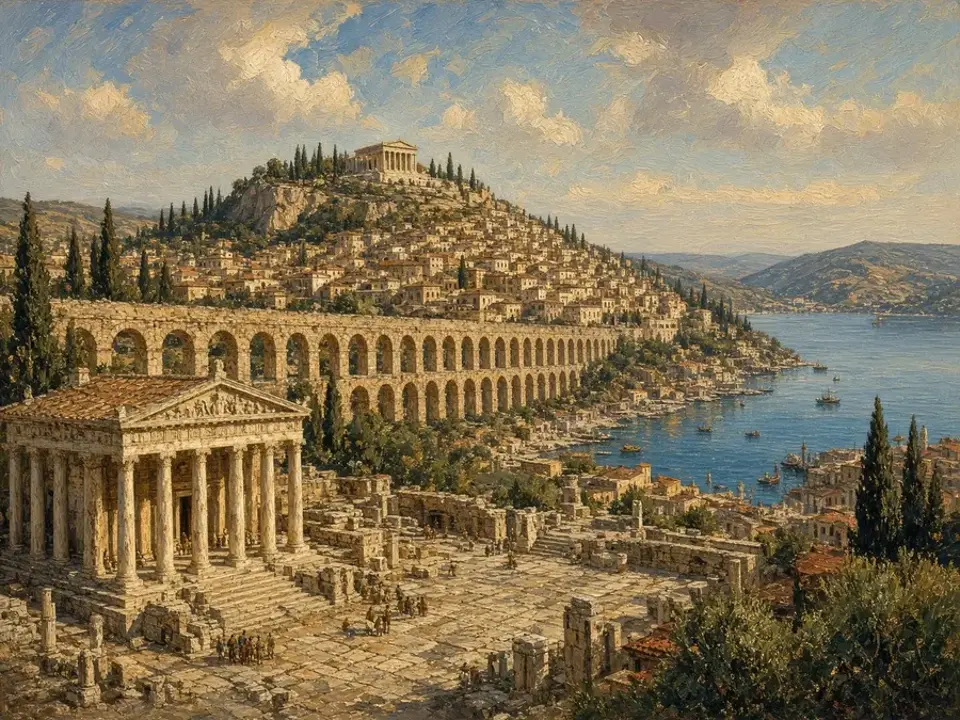
The Mediterranean littoral enabled a shared Greco-Roman cultural repertoire, urban network, and imperial institutions constituting a durable civilizational complex.
The framework read
The author's reading of this civilization.
- Geographic core: Mediterranean littoral with maritime connectivity binding urban nodes.
- Cultural-linguistic cohesion: Hellenic literary/civic traditions and Latin-legal frameworks; shared urban forms and elite culture.
- Political-economy: polis, federation, and imperial administrations with taxation and law.
- Continuity: transformations from classical to late antique to medieval transmissions retain recognizable civilizational frames.
Why it works — and how it breaks
- Success vector: S (law/citizenship + scalable incorporation) + G (professional legions + roads).
- Failure modes: S elite competition and legitimacy drift; G frontier costs/overextension; B shocks in high-connectivity empire.
By the numbers †
- GDPpeak ~$30 billion in 200 CE, ~25% of world GDP, largest global economy, decline 250-300 CE linked to crisis of third century
- Population45-60 million, peak ~60 million in 200 CE, ~32% of world population, decline 200-300 CE linked to disease ecology
- Urbanization15-20% urban population, largest city globally: Rome 800K-1.2M, high urbanization, decline 200-300 CE
- Fiscal Capacitytax revenue: $1.8B-$2.4B, tax-to-GDP ratio: ~8%, military spending: 50% to 60% of tax revenue, fiscal strain in 300 CE contributes to decline
- Technology Index68→65, Imperial peak, engineering excellence, transportation technology 18/20, decline during crisis, innovation rate 3-8 per century
- Institutional Metrics6-10 officials per 10K, 60% tax efficiency, 2,500 legal provisions, very high legal complexity, declining during crisis
- Demographic Structure32-34% under 15, 30-40 years life expectancy declining, 4-5 fertility, 28-40 mortality increasing, crisis period, demographic decline
- Infrastructure80,000+ km roads, 1,500 km aqueducts, 600 fortifications, 1,200 bridges, 85/100 sophistication index, exceptional infrastructure, Style axis support
† Scholarly estimates.
People over time
Population (millions) †
† Scholarly estimates, drawn as separately published segments. The line after 500 CE is the Byzantine (Eastern Roman) Empire, folded under Greco-Roman here as an editorial choice; the dashed break marks the 300–500 gap where there is no data.
Economy
† Estimates after Maddison, to 1945, log scale.
Polities as spans
Each bar opens its entry.
Turning points
- 1200 BCEBronze Age Collapse
- 431 BCE-404 BCEPeloponnesian War
- January-July 332 BCESiege of Tyre
- 331 BCEBattle of Gaugamela
- 330 BCEAlexander's Conquests Begin
- 264 BCE-241 BCEFirst Punic War
- 218 BCE-201 BCESecond Punic War
- 2 August 216 BCEBattle of Cannae
- 146 BCERoman Conquest of Carthage
- 27 BCERoman Empire Established
People
- Alexander the Great356-323
- Archimedes287-212
- Aristotle384-322
- Augustine of Hippo354-430
- Augustus (Octavian)63-14
- Julius Caesar100-44
- Constantine the Great272-337
- Diocletian244-311
Also in the chronicle
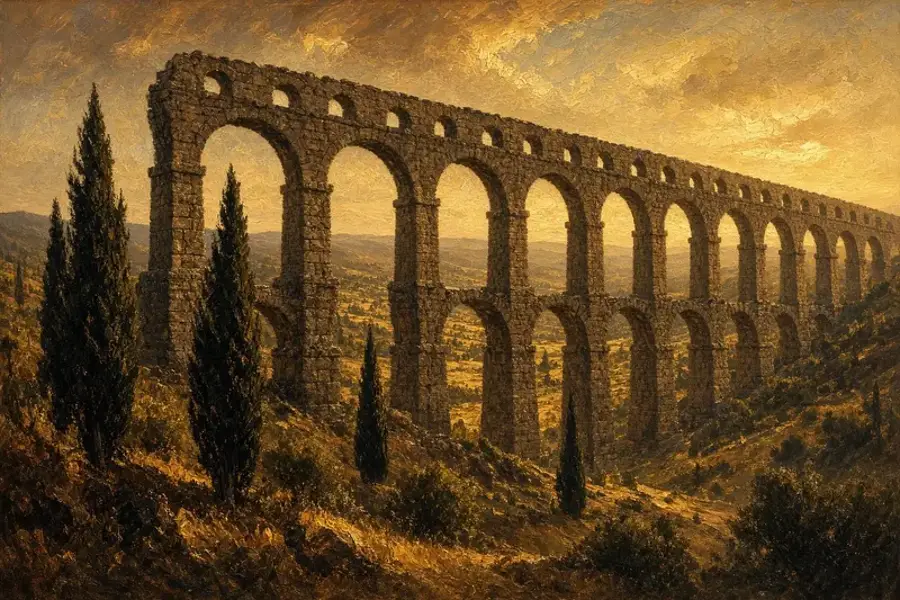
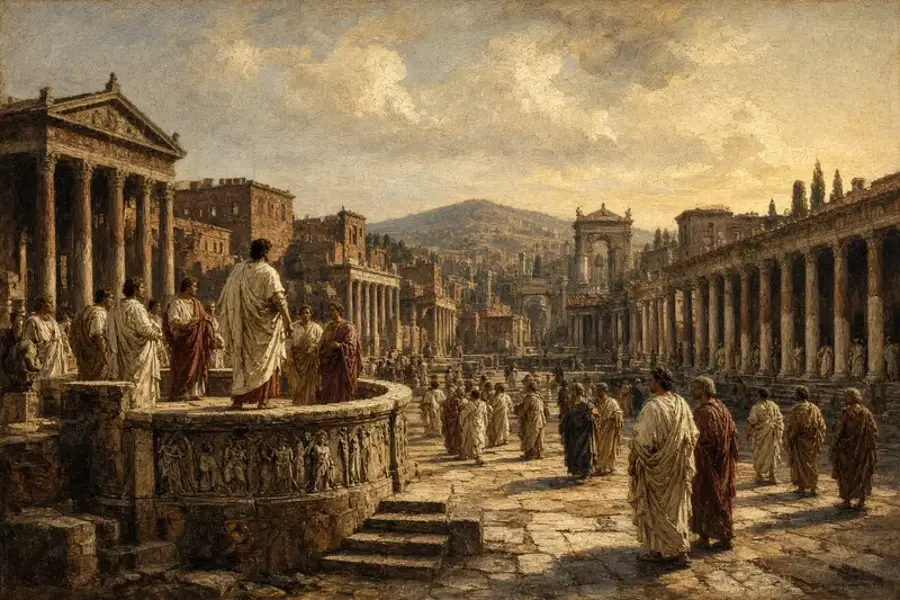
AI-made chronicle art; not evidence.
Patterns and comparisons
Ideas that help read this civilization alongside others.
- Trade Networks as Civilizational Connectors and Transformers [trade-network-dynamics]Pattern · Trade routes (maritime, overland, riverine) transmit technologies, ideas, and pathogens, creating syncretic zo
- Educational Systems and Elite Formation Across CivilizationsComparison · Compares educational systems (Confucian examinations, Islamic madrasas, European universities, monastic school
- Legal Systems Across CivilizationsComparison · Compares legal systems (Roman, Islamic, Chinese, common law) to identify patterns in how law structures govern
- Byzantine Civilization — Distinct or Greco-Roman Phase?Comparison · Evaluates whether Byzantine civilization (Eastern Roman Empire, 330-1453 CE) constitutes a distinct civilizati
- Succession Systems Across CivilizationsComparison · Compares succession systems (primogeniture, designated, elective, bureaucratic) across civilizations to identi
- Virtue Ethics and Character CultivationPattern · Virtue ethics (character cultivation, moral exemplars, virtue-based selection) shapes elite formation, legitim
- Epistemological Traditions Across CivilizationsComparison · Compares epistemological traditions (how civilizations structure knowledge, truth, and evidence) to identify p
Explore this civilization
Polities
- Achaean League
- Aetolian League
- Argos [argos]
- Argos [kingdom-of-argos]
- Athenian Empire (Delian League)
- Byzantine Empire
- Caliphate of Córdoba [caliphate-of-cordoba]
- Carthage
- Corinth [corinth]
- Corinth [kingdom-of-corinth]
- Delian League
- Holy Roman Empire
- Illyrian Kingdoms
- Kievan Rus
- Kingdom of Armenia
- Kingdom of Cyprus
- Kingdom of Georgia
- Kingdom of Greece
- Kingdom of Italy
- Kingdom of Malta
- Kingdom of Naples
- Kingdom of Sicily
- Kingdom of Thebes
- Macedonian Empire
- Milan
- Ottoman Empire
- Papal States
- Peloponnesian League
- Phoenicia
- Pisa
- Ptolemaic Kingdom
- Republic of Genoa
- Republic of Lucca
- Republic of Siena
- Republic of Venice
- Roman Empire
- Roman Republic
- Seleucid Empire
- Siena
- Sparta
- Thebes (Greece)
- Umayyad Emirate of Córdoba
- Western Roman Empire
Data cards
- Greco-Roman GDP Data (1945-present CE)
- Greco-Roman Military Data (1945-present CE)
- Greco-Roman Population Data (1945-present CE)
- Greco-Roman/Mediterranean Demographic Structure 100-300 CE
- Greco-Roman/Mediterranean Fiscal Data 100-300 CE
- Greco-Roman/Mediterranean GDP Data 100-300 CE
- Greco-Roman/Mediterranean Infrastructure Data 100-300 CE
- Greco-Roman/Mediterranean Institutional Metrics 100-300 CE
- Greco-Roman/Mediterranean Technology Index 100-300 CE
- Greco-Roman/Mediterranean Trade Volume Data 100-300 CE
- Greco-Roman/Mediterranean Urbanization Data 100-300 CE
- Roman Military Size Data 100-300 CE
- Roman Population Data 100-300 CE
Concepts
- Arabic–Latin Philosophical Transmission (Avicenna to Scholasticism)
- Architectural Iconography and Symbolic Architecture
- Augustinianism (Christian Neoplatonic Legacy)
- Creation Myths and Civilizational Style
- Dragon‑Slaying Motif (Chaoskampf)
- Epistemology Systems and Knowledge Structures
- Ethics Systems and Moral Frameworks
- Ficino and Renaissance Neoplatonism
- Flood Myths as Reset Narratives
- Lingua Francas and Administrative Languages
- Monetary Iconography and Currency Symbols
- Neoplatonism and Christian Thought
- Political Iconography and Authority Symbols
- Religious Iconography and Sacred Symbols
- Ritual Iconography and Ceremonial Symbols
- Scholasticism as Medieval Intellectual-Institutional Method
- Translation Systems and Cross-Linguistic Transmission
Patterns
People
Events
- Alexander's Conquests Begin (330 BCE)
- Battle of Cannae (216 BCE)
- Battle of Gaugamela (331 BCE)
- Battle of Pharsalus (48 BCE)
- Battle of Salamis (480 BCE)
- Bronze Age Collapse (1200 BCE)
- Caesar's Civil War (49-45 BCE)
- Crisis of the Third Century (250 CE)
- Fall of Constantinople (1453 CE)
- Fall of Western Roman Empire (476 CE)
- First Punic War (264-241 BCE)
- Peloponnesian War (431-404 BCE)
- Roman Conquest of Carthage (146 BCE)
- Roman Empire Established (27 BCE)
- Second Punic War (218-201 BCE)
- Siege of Tyre (332 BCE)
Comparisons
- Byzantine Civilization — Distinct or Greco-Roman Phase?
- Educational Systems and Elite Formation Across Civilizations
- Epistemological Traditions Across Civilizations
- Hellenistic World — Successor Civilization or Phase?
- Legal Systems Across Civilizations
- Lingua Francas Across Civilizations
- Moral Philosophy Across Civilizations
- Philosophical Influence Bridges Across Civilizations
- Religious Institutions and Civilizational Cohesion
- Succession Systems Across Civilizations
- Translation Traditions Across Civilizations
- World Ledger — GGS Mappings by Civilization
Conflicts in this civilization
Each conflict opens on its polity page. Evidence badges show how well each is sourced; stub-only conflicts carry no figures.
- 26 or 27 September 480 BCE Battle of Salamis (480 BCE) naval battle Primary text read
- 431 BCE-404 BCE Peloponnesian War (431-404 BCE) interstate war Primary text read
- Maimacterion (Nov-Dec), archonship of Nicostratus = 333 BCE Battle of Issus (333 BCE) battle Primary text read
- January-July 332 BCE Siege of Tyre (332 BCE) siege Primary text read
- 264 BCE-241 BCE First Punic War (264-241 BCE) interstate war Primary text read
- 218 BCE-201 BCE Second Punic War (218-201 BCE) interstate war Formal source
- 2 August 216 BCE Battle of Cannae (216 BCE) battle Primary text read
- 83 BCE-82 BCE Sulla's Civil War (83-82 BCE) civil war Primary text read
- 10 January 49 BCE-17 March 45 BCE Caesar's Civil War (49-45 BCE) civil war Primary text read
- 9 August 48 BCE Battle of Pharsalus (48 BCE) battle Primary text read
- 3 and 23 October 42 BCE Battle of Philippi (42 BCE) battle Primary text read
- 2 September 31 BCE Battle of Actium (31 BCE) naval battle Primary text read
- 634 CE-638 CE Muslim (Rashidun) Conquest of Syria/Levant (634-638 CE) conquest Primary text read
- 15-20 August 636 Battle of the Yarmuk (636 CE) battle Primary text read
- 1095 CE-1291 CE (conventional; convention cited to Tyerman 2006, book-level) Crusades (1095-1291 CE, conventional span) war series Primary text read
Art: Patterns of Civilization chronicle art, made with AI: illustrations, not historical evidence. Entries are drafts preserved from civilization.study. Method and sources.