
Work / Civilization / Civilizations / Ethiopian / Axumite
dossier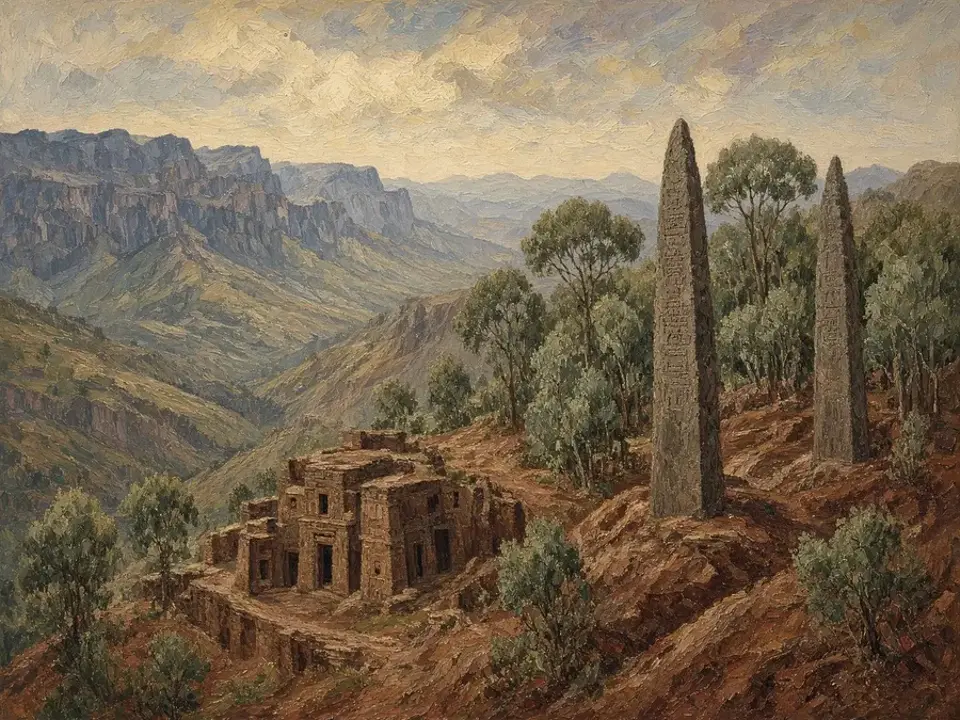
Chronicle art — an imagined landscape and ruler. Not historical evidence. 
Civilization
Ethiopian / Axumite
The Ethiopian highlands and Axumite core fostered a distinct civilization with unique script, Christian and pre-Christian phases, and durable institutional continuity from antiquity to the present.
The framework read
The author's reading of this civilization.
- Geographic core: Ethiopian highlands (Tigray, Amhara regions) with Axum as early core; highland geography enabling agricultural surplus and defensive advantage.
- Cultural-linguistic cohesion: Ge'ez script and language (Semitic family); Christian Orthodox traditions integrated with pre-Christian elements; distinctive architectural and artistic repertoires.
- Political-economy: Axumite empire with trade networks (Red Sea, Indian Ocean); later Ethiopian kingdoms with taxation and state administration; Solomonic dynasty legitimacy charters.
- Continuity: Recognizable civilizational identity from Axumite period (c. 1st century CE) through medieval Ethiopian kingdoms to modern Ethiopia, despite political transformations.
Why it works — and how it breaks
- Success vector: S (highland defensive advantage, Christian institutional integration, Solomonic legitimacy) + G (military organization, trade route control) + B (highland disease ecology advantages).
- Failure modes: S fragmentation (regional competition, succession disputes) + G external asymmetry (gunpowder/industrial tech from European rivals) + trade route disruption (Red Sea/Indian Ocean shifts) + environmental stress (highland agricultural limits).
What makes it a civilization
- Geography: Highland core (Ethiopian highlands) enabling surplus and defensive advantage
- Cultural-linguistic cohesion: Ge'ez script, Semitic language family, distinctive Christian and pre-Christian traditions
- Political-economy: State structures with taxation and administration (Axumite empire, Ethiopian kingdoms)
- Urbanization: Persistent urban centers (Axum, Lalibela, Gondar, Addis Ababa)
- Continuity: Recognizable identity from antiquity to present (c. 2000 years)
By the numbers †
- GDPpeak ~$2.5 billion in 1500 CE, ~1.5-2% of world GDP, highland adaptation, Red Sea/Indian Ocean trade
- Population1.5-5 million, moderate density 5-9/km², highland adaptation
- Urbanization10-17% urban population, moderate urbanization, largest city: Axum 50K-80K in 500 CE, Gondar 40K-60K in 1500 CE, highland adaptation
- Fiscal Capacitytax revenue: $0.05B-$0.20B, tax-to-GDP ratio: ~8%, military spending: 40-50% of tax revenue, highland adaptation fiscal systems, trade network integration
- Technology Index42→48, moderate level, highland adaptation, Christian scholarly networks, trade network integration - Red Sea/Indian Ocean, innovation rate 2-5 per century
- Institutional Metrics6-10 officials per 10K, 65% tax efficiency, 150-300 legal provisions, moderate, highland adaptation, Christian integration
- Demographic Structure37% under 15, 28-35 years life expectancy, 5-6 fertility, 34-41 mortality, highland adaptation, very high mortality
- Infrastructure3,000-5,000 km roads, 1,000-2,000 km canals, 100 fortifications, 50 bridges, 66/100 sophistication index, trade route infrastructure, highland adaptation, Red Sea/Indian Ocean trade, Style a
† Scholarly estimates.
People over time
Population (millions) †
† Scholarly estimates, drawn as separately published segments.
Economy
† Estimates after Maddison, to 1945, log scale.
Polities as spans
Each bar opens its entry.
Turning points
- c. 520–525 CEAksumite intervention in Himyar
People
- Ezana of Axumr. c. 320–c. 360 CE
Also in the chronicle
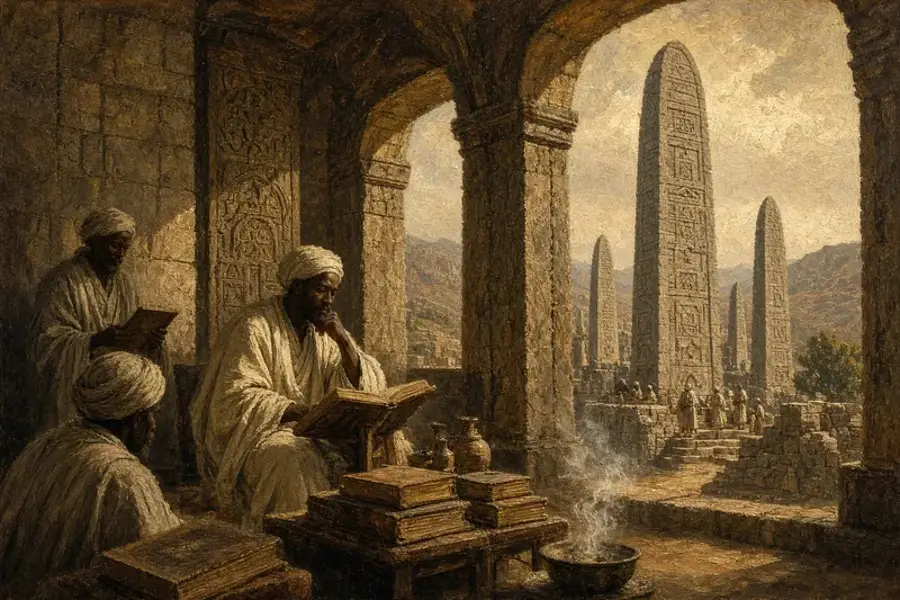
AI-made chronicle art; not evidence.
Patterns and comparisons
Ideas that help read this civilization alongside others.
- Trade Networks as Civilizational Connectors and Transformers [trade-network-dynamics]Pattern · Trade routes (maritime, overland, riverine) transmit technologies, ideas, and pathogens, creating syncretic zo
Explore this civilization
Polities
Data cards
- Ethiopian/Axumite Civilization Fiscal Data 100-1500 CE
- Ethiopian/Axumite Civilization GDP Data 100-1500 CE
- Ethiopian/Axumite Civilization Military Size Data 100-1500 CE
- Ethiopian/Axumite Civilization Population Data 100-1500 CE
- Ethiopian/Axumite Demographic Structure 100-1500 CE
- Ethiopian/Axumite GDP Data (1945-present CE)
- Ethiopian/Axumite Infrastructure Data 100-1500 CE
- Ethiopian/Axumite Institutional Metrics 100-1500 CE
- Ethiopian/Axumite Military Data (1945-present CE)
- Ethiopian/Axumite Population Data (1945-present CE)
- Ethiopian/Axumite Technology Index 100-1500 CE
- Ethiopian/Axumite Urbanization Data 100-1500 CE
Concepts
People
Art: Patterns of Civilization chronicle art, made with AI: illustrations, not historical evidence. Entries are drafts preserved from civilization.study. Method and sources.