
Work / Civilization / Civilizations / Southeast Asian maritime

Southeast Asian maritime
A maritime-centered complex in Southeast Asia integrated archipelagic and peninsular nodes through trade, religious-court cultures, and hybrid institutions over centuries.
The framework read
The author's reading of this civilization.
- Geographic core: archipelagic and peninsular littorals (e.g., Srivijaya, Majapahit, Melaka) connected via monsoon routes.
- Cultural-linguistic cohesion: Malay and related lingua francas; Indic, Sinitic, and later Islamic court and religious repertoires.
- Political-economy: port polities, tolls/market regulation, and regional trade networks linking Indian Ocean and South China Sea.
- Continuity: maritime institutional patterns persist across dynastic and religious transitions.
Why it works — and how it breaks
- Success vector: S (port network coordination, toll/market regulation) + trade network advantages (monsoon routes linking Indian Ocean and South China Sea).
- Failure modes: S fragmentation (port polity competition) + route shifts (chokepoint vulnerability) + external pressure (Sinitic, Indic, Islamic, later European maritime powers).
By the numbers †
- GDPpeak ~$6.6 billion in 1500 CE, ~3-4% of world GDP, port polity economies, monsoon trade routes
- Population10-22 million, moderate growth, maritime trade network integration
- Urbanization10-15% urban population, moderate urbanization, largest city: Melaka 80K-120K in 1500 CE, port polity cities
- Fiscal Capacitytax revenue: $0.24B-$0.53B, tax-to-GDP ratio: ~8%, military spending: 50-52% of tax revenue, trade-based fiscal systems, port polity economies
- Technology Index46→54, moderate-high level, maritime technology excellence - transportation 14/20, high diffusion rate, syncretic zones, innovation rate 3-7 per century
- Institutional Metrics7-12 officials per 10K, 70% tax efficiency, 200-500 legal provisions, moderate-high, trade-based systems, syncretic integration
- Demographic Structure37% under 15, 30-36 years life expectancy, 5-6 fertility, 33-39 mortality, maritime trade integration, balanced structure
- Infrastructure10,000-15,000 km roads, 2,000-4,000 km canals, 200 fortifications, 120 bridges, 80-150 ports, 68/100 sophistication index, advanced port infrastructure, maritime trade focus, Style axis supp
† Scholarly estimates.
People over time
Population (millions) †
† Scholarly estimates, drawn as separately published segments.
Economy
† Estimates after Maddison, to 1945, log scale.
Polities as spans
Each bar opens its entry.
People
- Suryavarman IIr. 1113–c. 1150 CE
- Jayavarman VIIr. c. 1181–c. 1218 CE
Also in the chronicle

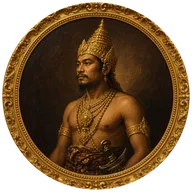
AI-made chronicle art; not evidence.
Patterns and comparisons
Ideas that help read this civilization alongside others.
- Trade Networks as Civilizational Connectors and Transformers [trade-network-dynamics]Pattern · Trade routes (maritime, overland, riverine) transmit technologies, ideas, and pathogens, creating syncretic zo
- World Ledger — GGS Mappings by CivilizationComparison · Compact mapping of major civilizations' success vectors and failure modes using Guns–Germs–Style; highlights r
- Lingua Francas Across CivilizationsComparison · Compares lingua francas (administrative and scholarly languages) across civilizations to identify patterns in
Explore this civilization
Polities
Data cards
- Southeast Asian Maritime Civilization Fiscal Data 800-1500 CE
- Southeast Asian Maritime Civilization GDP Data 800-1500 CE
- Southeast Asian Maritime Civilization Military Size Data 800-1500 CE
- Southeast Asian Maritime GDP Data (1945-present CE)
- Southeast Asian Maritime Military Data (1945-present CE)
- Southeast Asian Maritime Population Data (1945-present CE)
- Southeast Asian Maritime Trade Volume Data 800-1500 CE
- Southeast Asian Maritime Urbanization Data 800-1500 CE
- Southeast Asian/Maritime Civilization Population Data 800-1500 CE
- Southeast Asian/Maritime Demographic Structure 800-1500 CE
- Southeast Asian/Maritime Infrastructure Data 800-1500 CE
- Southeast Asian/Maritime Institutional Metrics 800-1500 CE
- Southeast Asian/Maritime Technology Index 800-1500 CE
Concepts
Conflicts in this civilization
Each conflict opens on its polity page. Evidence badges show how well each is sourced; stub-only conflicts carry no figures.
- 1025 CE-1026 CE Chola Invasion of Srivijaya (1025-1026 CE) naval expedition Primary text read
- 1258, 1283-1285, 1287-1288 Mongol Invasions of Vietnam (1258-1288 CE) war series Primary text read
- 22 January-early August 1293 Mongol (Yuan) Invasion of Java (1293 CE) naval expedition Primary text read
Art: Patterns of Civilization chronicle art, made with AI: illustrations, not historical evidence. Entries are drafts preserved from civilization.study. Method and sources.