
essay
The Present Bearer
View full artwork →
“The architect’s duty is to reconcile the abstract and the real; to bind heaven and earth in intelligible form.”
Every genealogy terminates in a living person. Every family line, however long its memory, however deep its archive, arrives finally at someone who must decide what to do with the inheritance. Not merely to receive it, but to bear it—to carry the weight of what was transmitted and to add something before passing it forward.
For me, that inheritance runs from Loyalist sergeant James Dawson through eight generations. This is a personal account of what it asks of me.
I. The Inheritance
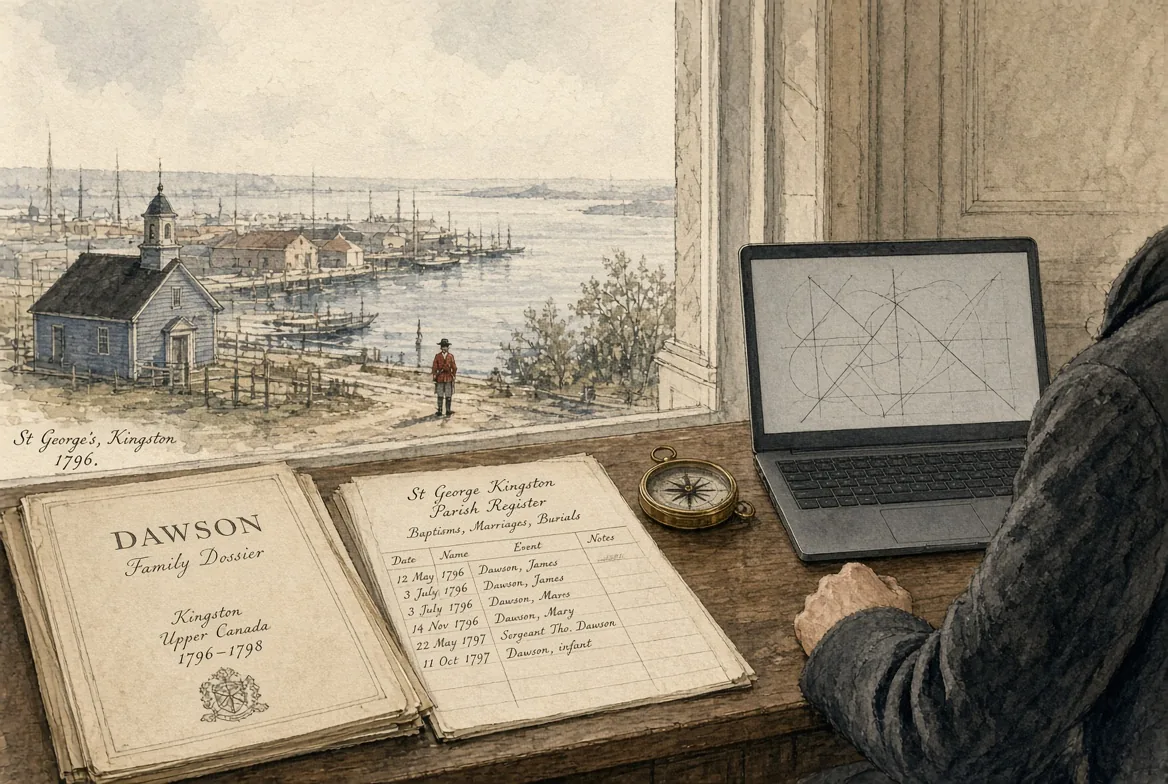
James Dawson, United Empire Loyalist, sergeant, a Kingston constable, received his Crown patent for Lot 123 in 1807. He did not know he was founding a line. He was surviving—choosing the Crown over the Republic, order over revolution, continuity over rupture. That choice echoed for eight generations.
The Dawson line did not produce a dynasty. It produced continuity. Through the Gildersleeve connection, through the Ansley alliance and the industrial settlements at Battersea, through parish records and civic archives, the pattern repeats: modest people building durable things. Not fame, but presence. Not wealth, but stability. Not spectacle, but craft.
Eight generations later, the inheritance arrives at my desk in Toronto. The question is not whether to accept it—I cannot refuse what formed me. The question is whether to understand it, and what to build with that understanding.
II. The Formation
Understanding requires reconstruction. My formation was not linear. It moved through periods of questioning, dismantling assumptions and finding a more coherent way to live. The old alchemical image of dissolution before renewal captures something of that experience.
The Early Discipline
The first evidence of pattern arrived early. As a teenager monetizing virtual assets in Diablo II, I was not playing a game—I was learning markets, incentive structures, the difference between perceived and actual value. And the ninety pounds I lost through sheer disciplined self-management was not a health project. It was proof of concept: that systems respond to sustained, principled pressure.
These are small things. But small things reveal character when they are examined honestly. The pattern was already present: identify inefficiency, master the system, compound progress toward something durable.
The Working Architecture
The formal trajectory reads as career progression. It was actually a curriculum in institutional architecture.
My working life has been spent building systems meant to endure—in finance, technology, and stewardship under audit discipline.
The guiding principle was always the same: build systems that endure.
III. Infrastructure of Thought
My work on an intelligence platform brought one commitment into focus: information should be traceable. The aim was to connect institutional data while keeping each claim tied to an authoritative public source.
The pattern beneath the platform is not technological. It is epistemological: truth should be traceable. The same principle governs the genealogical research and this Ledger. Every claim should leave a trail. Every assertion should be testable. Every structure should make its load-bearing logic visible.
This is not paranoia or bureaucratic compulsion. It is the architect’s creed applied to cognition itself. When you build systems that others will depend on—whether institutional architectures, family legacies, or this Ledger—opacity is not humility. It is negligence.
IV. The Return to the Craft
The working life explains competence. It does not explain purpose. Purpose required a different kind of architecture.
I was initiated into Freemasonry in 2022 at Harcourt Lodge No. 581, Grand Lodge of Canada in the Province of Ontario, and was raised to Master Mason in 2024. My return restored a Craft thread in the Dawson line after a generation of silence.
These facts require context to carry their weight.
The Dawson line’s Masonic thread runs from James the Loyalist in 1795, through the Victorian expansion, through my grandfather James Glen’s postwar membership at the Craft’s peak, and into the generation-long silence when William George watched the institutional world of Freemasonry contract and chose not to enter the Craft. The family account is set out in The Dawson Legacy. What matters here is what the return felt like from the inside.
Walking into Harcourt Lodge for the first time meant walking into a room where time operated differently. The ritual has not changed in its essentials since the eighteenth century. The charges spoken over me were spoken over men in my line two centuries ago. The working tools placed in my hands were explained to candidates before Confederation. I was not joining an organization. I was entering a current—one that was interrupted in my family for a single generation, but never in the Craft itself.
My return was not nostalgic—Freemasonry is not a heritage society. Not social—the Craft’s demanding ritual calendar is a poor strategy for networking. The return was architectural: Freemasonry provides a moral geometry, a set of working tools for building character the way a mason builds a wall. Level and plumb. Square and compasses. The rough ashlar shaped toward the perfect.
What the lodge teaches cannot be summarized in propositions. It is transmitted through ritual—through the physical act of moving through degrees, memorizing charges, learning to guard a door before you are trusted to govern a communication. The institution asks you to pay with time, discipline, and vulnerability before it shares what it knows. And what it knows is not secret doctrine but practical wisdom: that character is built through structured repetition, that integrity means alignment between word and deed, that the measure of a man is what he builds for others.
The Craft restored something the working life could not provide: a vocabulary for moral purpose that was neither corporate nor purely theological but operative—rooted in the physical act of building.
V. The Return to the Communion
Faith followed a different path but arrived at the same destination.
I was raised Roman Catholic. An interlude of atheism—the honest kind, born of genuine philosophical objection rather than convenience. Then a return, not to Rome but to Canterbury. The Anglican tradition offered what I needed: sacramental structure without intellectual captivity, theological depth without doctrinal rigidity, a liturgical inheritance that valued beauty and reason in equal measure.
The return to the Church, like the return to the lodge, was not sentimental. It was architectural. The Anglican Communion provides what no secular institution can: a framework in which truth is treated as sacred, stewardship is grounded in vocation, and the passage of time is sanctified by liturgical rhythm. Ordinary Time is not empty time. Advent is not merely waiting. The Church year teaches that cyclical return is not repetition—it is deepening.
VI. The Cathedral in Code
All of this—the working life, the Masonic formation, the sacramental return—converges in a single project: The Dawson Ledger.
When I wrote this essay in February 2026, the first Ledger was a full-stack content platform: React 18, TypeScript, Vite, Express, PostgreSQL, Drizzle ORM, Tailwind CSS, TanStack Query, OpenAI embeddings. One hundred and twenty-one essays across nine families, seven domains, twelve patterns, and three archetypes. A Resonance Engine computing harmonic connections between ideas. A Formation Architecture tracking reader transformation. A Liturgical Calendar marking sacred time. An AI Docent guided by eight guardrails. Golden ratio typography. Sacred number spacing. Route-based code splitting. Privacy-first analytics.
I called that first Ledger a cathedral in code. The image expressed an ambition: to make beauty, patient work and conviction visible in something I built.
A cathedral is a structure that encodes theology in stone—that makes invisible commitments visible through material form. I wanted the first Ledger to do something similar with ideas. Its taxonomy was meant to express an epistemology: the way essays are organized reflects commitments about how knowledge relates to knowledge, how domains interpenetrate, how patterns recur across seemingly unrelated fields. Its use of colour is not decoration but pedagogy: colour carries meaning, and the shift from sage blue to architect gold to magician violet teaches something about the kind of knowledge being engaged. Its sacred geometry is not affectation but confession: the golden ratio appears in the typography, the spacing, the animation timing because I believe that mathematical harmony is not imposed on reality but discovered within it.
The rebuilt Ledger carries that intent into a simpler publication. Its architecture has changed; the responsibility remains mine. Faith belongs to the person doing the work, and the site is one place to share that work. What I learned from building the first Ledger describes the change.
Vitæ Via Virtus — Virtue is the way of life.
The Ledger took thousands of hours. It will take thousands more. This is not a complaint. It is a commitment. Cathedral time—the willingness to build on a timescale that exceeds your own life—is not impractical. It is the only timescale on which anything worth building can be built. The Dawson line proves it across eight generations. The Ledger embodies it in code.
VII. The Meta-Patterns
Step back far enough and my life resolves into a small set of recurring patterns:
Integration. Finance and technology. Faith and reason. The Craft and the Communion. Public data and sacred geometry. The pattern is always the same: take things that others treat as separate and build the architecture that reveals their unity.
Auditability. Every claim traceable. Every decision logged with evidence. Every structure making its load-bearing logic visible. From audit discipline through the genealogical archive to the Ledger’s documented systems, the commitment is constant: truth leaves a trail.
Architectural thinking. Build to endure. Not the fastest solution or the most impressive—the one that will still be standing when the fashions change. The intelligence platform, the genealogical archive, the Ledger: each is an attempt to build something that outlasts me.
Faithful rationalism. Symbol with substance. The Craft’s moral geometry is not mysticism—it is practical wisdom transmitted through ritual form. The Church’s sacraments are not magic—they are covenants made physical. The Ledger’s sacred geometry is not decoration—it is confession. In every case, the commitment is the same: believe that reality has structure, and build accordingly.
Stewardship over speed. My portfolio targets multi-generational wealth to fund philanthropic, educational, and civic projects rooted in classical and Masonic values. My working life optimizes for institutional stability rather than personal advancement. The Ledger builds on cathedral time. My investment philosophy treats capital as a tool for discovery and stewardship. The scoreboard includes compounded knowledge, not return alone.
VIII. The Bearing
The word bearer is chosen deliberately. It carries three meanings simultaneously.
First, the genealogical sense: a custodian of the Dawson family record and its developing armorial design, responsible for their accuracy and transmission. The family crest remains a draft pending finalization for heraldic registration.
Second, the architectural sense: a load-bearing member, the element in a structure that carries weight from above and transfers it to the foundation below. Eight generations of accumulated virtue, knowledge, and responsibility rest on my capacity to hold them and pass them forward.
Third, the vocational sense: to bear something is to carry it willingly, knowing its weight, accepting its cost. The Dawson inheritance is not a privilege to be enjoyed but a responsibility to be discharged. The line endures not because it is lucky but because each generation bears what it receives and adds something before transmitting.
The next generation will inherit the crest, the archive, the Masonic heritage, the Anglican covenant, the Ledger, and the commitment to craft over performance, truth over comfort, stewardship over speed—not as doctrine but as architecture: a set of structures within which they can build.
My task is not to complete the building. It is to lay courses of stone that the next generation can build upon. The family history, the archive and the institutions matter because they give the next generation something to build with.
Coda
The secular cycle theorists—Strauss and Howe, Turchin, Spengler—diagnose civilizational decline as though it were terminal. The Dawson line offers a counter-thesis: decline is reversible, but only through particular persons who choose to bear the weight of restoration.
The return is not abstract. It is not statistical. It is there when I walk into a lodge in 2022, speak words my ancestors spoke, and submit to a ritual that predates my nation. It is a cathedral in code, built essay by essay, system by system, on the conviction that what you build reveals what you believe.
The line does not merely survive.
It builds.